

Blog
Hawk Performance Brake Pads Guide: HPS vs HPS 5.0 vs HP Plus vs Ceramic vs DTC-70

Most “brake upgrade” conversations start with big calipers and slotted rotors, but the part that actually turns heat into stopping power is the brake pad. Change the friction compound and you change how hard the car stops, how the pedal feels, how much dust ends up on your wheels, and how the brakes behave after the fifth hard stop in a row. That’s why Hawk Performance brake pads have been a go-to for enthusiasts and racers for decades. Hawk offers the same pad shape in several different friction compounds, so you can tune your brakes to the way you drive without changing anything else.
At TotalZParts we stock the core Hawk lineup: Performance Ceramic, HPS, HPS 5.0, HP Plus and DTC-70, for everything from Infiniti G37s and Mustangs to Porsche 911s, C8 Corvettes and Brembo, AP Racing and Alcon big brake calipers. This guide explains how each compound works, how to read Hawk’s friction charts and part numbers, and which pad belongs on your car.
Hawk Brake Pads at a Glance: The Quick Answer
- Performance Ceramic (code Z): the quietest, cleanest Hawk street pad. Best for daily drivers and luxury or European cars where dust and noise matter most.
- HPS, High Performance Street (code F): Hawk’s classic street upgrade. Smooth, predictable and gentle on rotors, with Hawk rating it at 20–40% more stopping power than most standard replacement pads.
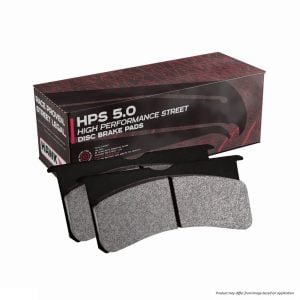
- HPS 5.0 (code B): more bite and a wider temperature range than HPS. Built for powerful street cars and spirited canyon driving, and it can handle occasional light track use with proper cool-downs.
- HP Plus (code N): a street-legal crossover pad for autocross and track days. Much higher friction and heat capacity, with more dust and noise.
- DTC-70 (code U): a dedicated race compound with extremely high torque, built to work at 800–1,200°F. Race use only.
- Every Hawk compound is designed for iron rotors. Hawk states its pads are not compatible with carbon ceramic rotors.
How Brake Pad Compounds Work (and Why Temperature Is Everything)
Your brakes stop the car by turning motion into heat. The pad squeezes the rotor, and friction between the two converts the car’s kinetic energy into heat that has to soak into the pad, rotor and caliper and then escape into the air. The friction compound decides how much stopping force you get for a given pedal pressure. It also decides at what temperature that force is available.
Engineers describe this with the coefficient of friction, written μ (“mu”). A higher μ means more stopping force from the same pedal effort. No compound has a perfectly flat μ, though. Every pad has a temperature window where it grips best (its optimal range) and a wider window it can survive (its operating range). Push a pad past the top of its range and friction falls away. That’s brake fade, and it’s what makes the pedal go long and soft halfway down a mountain road or at the end of a fast lap. Run a race pad too cold on the street and the opposite happens: it never reaches the temperature where it grips properly.
That’s the whole idea behind Hawk’s lineup. Each compound is tuned for a different temperature window, so the right pad is the one whose window matches the heat your driving actually produces.
Bedding: The Transfer Layer
Performance pads don’t just grind against bare iron. During bedding (break-in), a thin, even layer of pad material is deposited onto the rotor face. From then on the pad is largely gripping its own material, which gives stronger, smoother and more consistent braking. That’s why the bedding procedure further down this guide matters as much as the compound you pick.
Inside a Hawk Brake Pad: More Than Just Friction Material
Hawk street pads are built as a complete system. Each layer has a specific job:
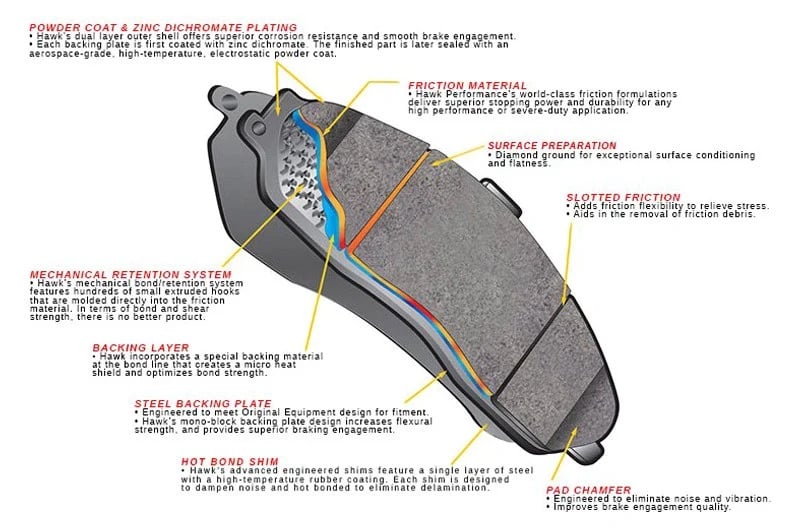
- Friction material: the compound itself (Ceramic, HPS, HPS 5.0 and so on). This is what you’re choosing when you pick a Hawk pad.
- Diamond-ground surface: the friction face is ground flat for good surface contact from the first stop.
- Slot and chamfers: the center slot relieves stress in the pad and gives friction debris somewhere to go. The angled chamfers at the edges reduce noise and vibration and smooth out initial engagement.
- Mechanical retention system: hundreds of small hooks extruded from the backing plate are molded directly into the friction material, so the friction block stays locked to the plate under heat and shear loads.
- Backing layer: a layer between the friction material and the plate that acts as a heat shield and strengthens the bond.
- Steel backing plate: engineered to the original equipment design for correct fit, with a corrosion-resistant zinc plating and powder coat finish.
- Hot bond shim: a rubber-coated steel shim bonded to the back of the plate to damp noise without delaminating.
Reading Hawk’s Friction Charts
Hawk publishes a friction-versus-temperature graph for its compounds. These charts are the most useful tool for comparing pads, so it’s worth knowing how to read them. The vertical axis is the coefficient of friction (μ) and the horizontal axis is brake temperature in °F. A higher line means more bite. A flatter line means the pad feels the same cold or hot, so the pedal is predictable.
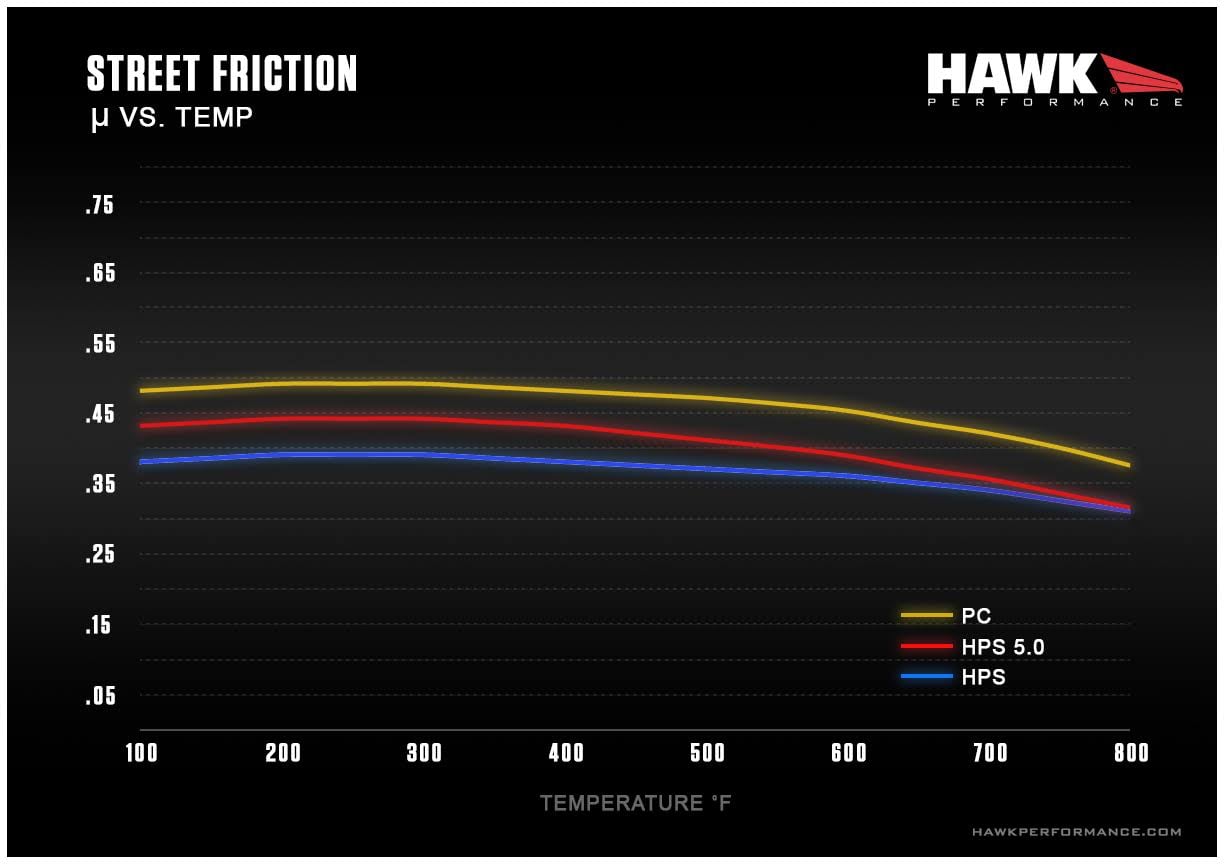
A few things stand out on Hawk’s street chart:
- All three street compounds work from cold. Each one makes useful friction at 100°F, which is exactly what you want on the street, where the first stop of the day happens with cold brakes.
- They’re spaced in steps. HPS runs at roughly 0.38–0.39 μ through its sweet spot, HPS 5.0 at roughly 0.43–0.44, and Performance Ceramic plots highest at about 0.48–0.49.
- They taper gently as heat climbs. All three lines ease down past about 600°F, which is why Hawk positions them as street pads rather than track pads.
Values are read from Hawk Performance’s published chart and are approximate.
Hawk Compound Comparison
| Compound | Code | Optimal range | Operating range | Best for | Dust & noise |
|---|---|---|---|---|---|
| Performance Ceramic | Z | 100–450°F | 100–650°F | Daily driving, luxury and European cars | Lowest |
| HPS | F | 100–500°F | 100–700°F | Spirited street driving, OE upgrade | Low |
| HPS 5.0 | B | 100–550°F | 100–750°F | Powerful street cars, canyon runs, occasional light track use | Low to moderate |
| HP Plus | N | 300–600°F | 100–800°F | Autocross, track days, aggressive street | Moderate to high |
| DTC-70 | U | 800–1,200°F | 400–1,600°F | Road racing and dedicated track cars only | High |
Temperature ranges as published by Hawk Performance.
Hawk Performance Ceramic: Quiet, Clean and Stronger Than Stock
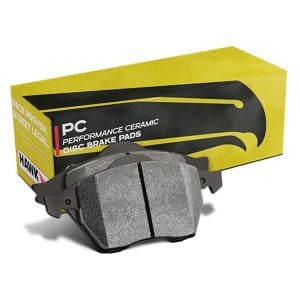
Performance Ceramic is Hawk’s answer to the driver who wants a real upgrade over OE pads but won’t accept noise or black wheels. Hawk lists it as extremely quiet and ultra-low dust, gentle on rotors for long pad life, and stable in friction output, with an optimal range of 100–450°F. On Hawk’s street chart it also shows the highest friction of the three street compounds through normal driving temperatures, so “quiet” doesn’t mean “weak.”
Choose Performance Ceramic if you drive mostly on the street, you have expensive or intricate wheels you’re tired of scrubbing, or you own a European car whose OE pads dust heavily. It’s a natural fit for Porsche, Audi, VW, BMW and Corvette owners who want stronger brakes without changing the car’s refined character.
Skip it if you plan to run track days. With an operating ceiling of 650°F, it isn’t built for repeated high-speed stops.
Hawk HPS (High Performance Street): The Proven Street Upgrade
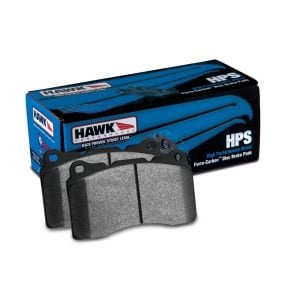
HPS is the compound that built Hawk’s street reputation. It’s a Ferro-Carbon formula that gives you a noticeable step up in bite over most replacement pads while keeping the smooth, quiet manners of a street pad. Hawk’s own feature list sums it up: smooth braking feel, consistent release, increased stopping power, and gentle on rotors with extended pad life. Its 100–500°F optimal range covers everything from the morning commute to a hard back-road drive.
Choose HPS if you want a clear improvement over stock with almost no trade-offs. It’s an ideal match for sport sedans, coupes and muscle cars that see enthusiastic street driving but no track time. Thanks to its cold friction and smooth release, it’s also easy to modulate in traffic.
HPS vs. Performance Ceramic: both are true street pads. HPS has a more traditional performance-pad feel, while Performance Ceramic prioritizes the lowest dust and noise. If clean wheels are your top priority, go Ceramic. If you want a classic performance pedal feel, go HPS.
Hawk HPS 5.0: Maximum Street Performance Without Fighting Your ABS
HPS 5.0 isn’t a replacement for HPS. It’s the next step up. Hawk designed it to deliver aggressive torque and high deceleration rates while still working smoothly with modern ABS and stability systems. That balance matters because too much friction can make the ABS intervene early and harshly, while too little doesn’t improve anything. Like HPS, it’s a Ferro-Carbon compound, but with a wider 100–550°F optimal range and a 750°F operating ceiling.
- More bite than HPS across Hawk’s street friction chart.
- Smooth, predictable control and consistent release, so it still drives like a street pad.
- Great rotor and pad wear life for a high-performance compound.
- Light track capability: it can handle occasional light track or autocross use if you watch for signs of overheating and give the brakes time to cool. It isn’t a race pad, though, so it won’t survive long, hot sessions.
Choose HPS 5.0 if you have a high-horsepower street car (Mustang GT, Camaro SS, Challenger, M car, Corvette, 911) and want the strongest street pad Hawk makes. It’s also a smart pick if you mostly drive on the street but sometimes do a canyon run or an autocross.
Hawk HP Plus: The Street-Legal Track Day Pad
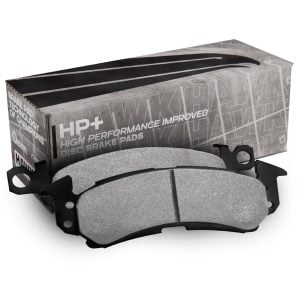
HP Plus (often written HP+) is where Hawk’s lineup crosses from street into motorsport. It’s a Ferro-Carbon compound developed for autocross, SCCA Solo, and track day use, with an optimal range of 300–600°F and an operating range up to 800°F. That higher optimal window is the key: HP Plus comes alive as the brakes get hot, which is exactly what happens on a track. Its fade resistance and smooth, predictable torque give you confidence lap after lap.
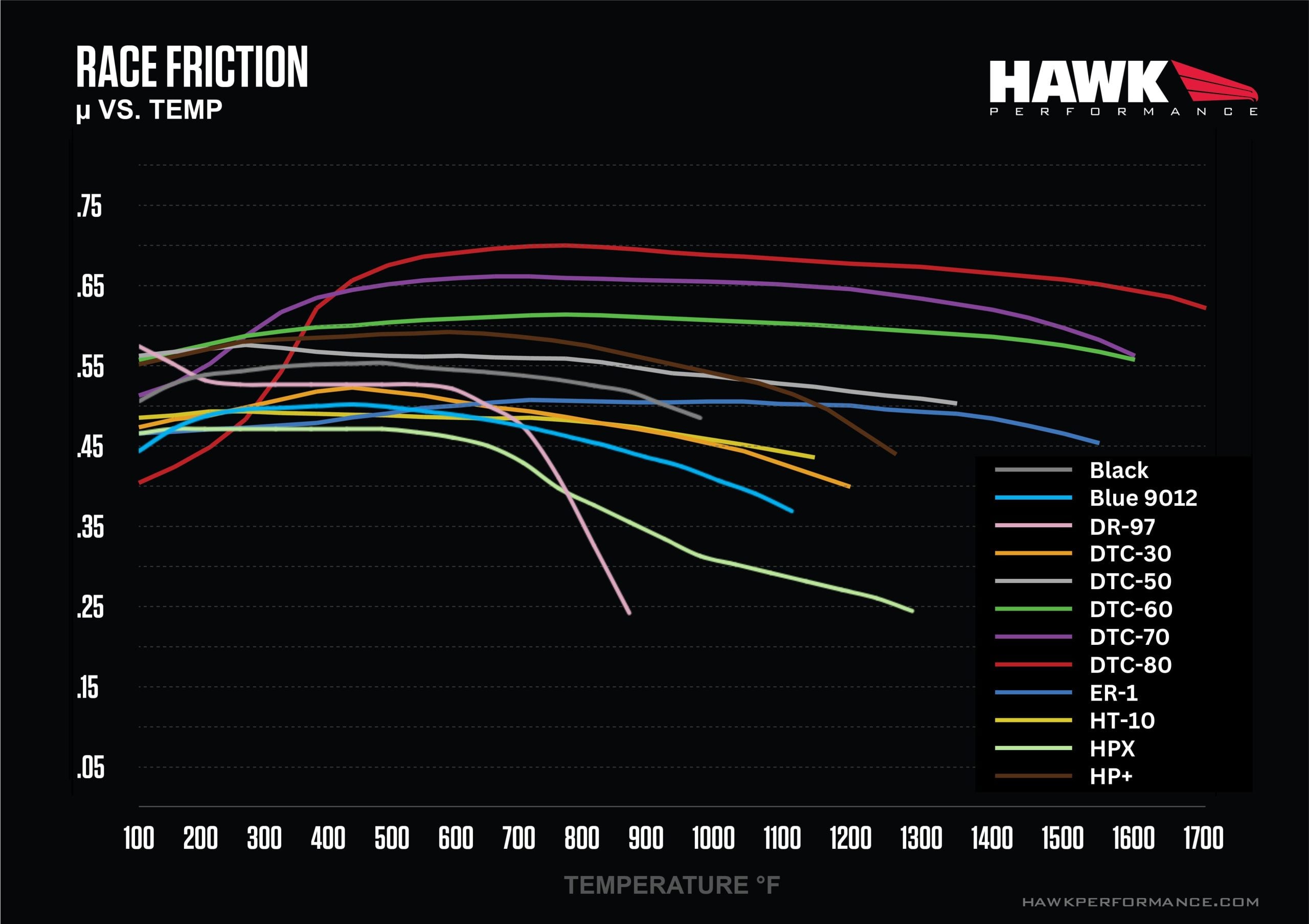
On Hawk’s race friction chart, HP Plus holds roughly 0.57–0.59 μ from cold all the way to about 800°F. That’s a big step above the street pads, and it’s available from the first stop. It then falls off sharply past roughly 1,000°F, which marks the line between a track day pad and a true race pad.
The trade-offs: HP Plus makes more dust and noise than Hawk’s street pads, and it can wear rotors faster. It’s street legal and many drivers run it full time on dual-purpose cars, but if your car rarely leaves the street, HPS 5.0 will be more pleasant to live with.
Choose HP Plus if you do autocross or HPDE/track days and want to drive to the event, run all day and drive home without swapping pads.
Hawk DTC-70: Dynamic Torque Control for the Race Track
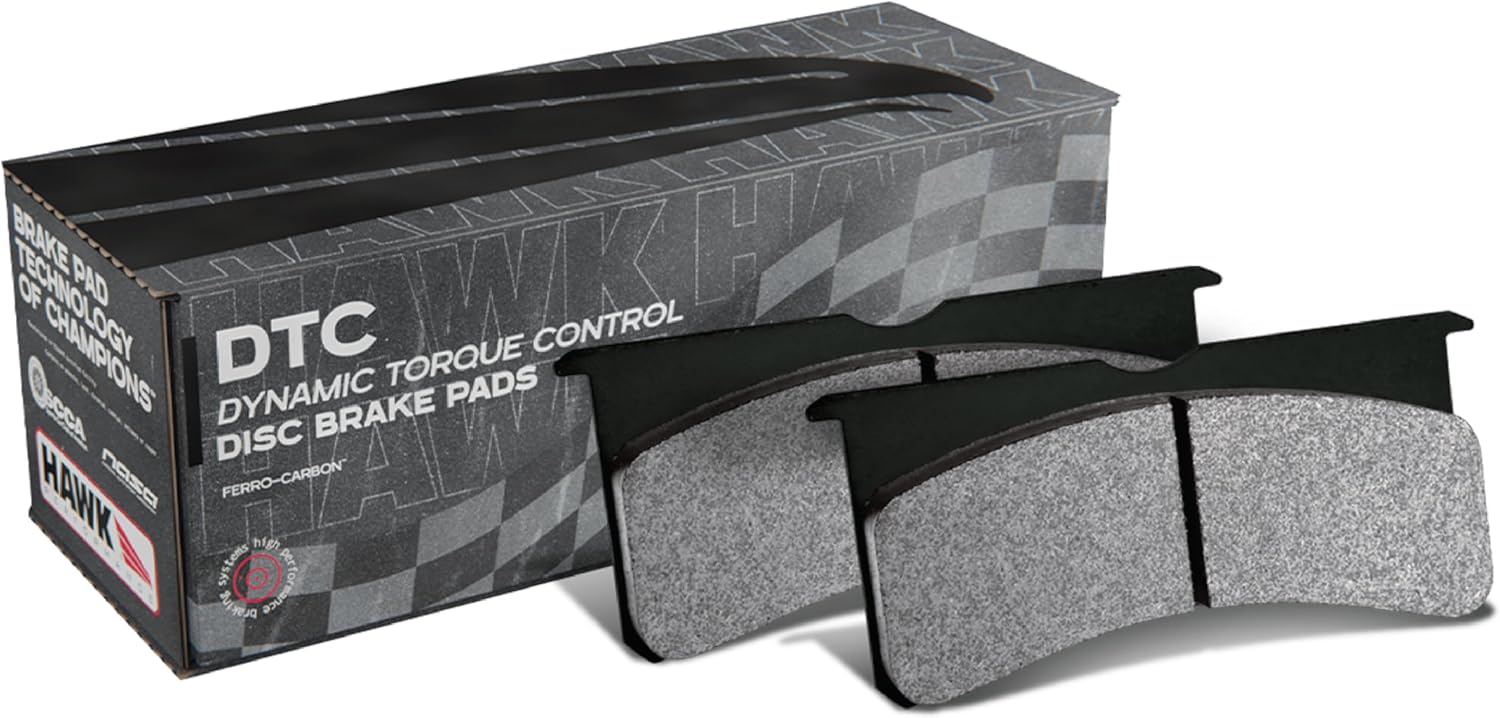
DTC stands for Dynamic Torque Control, Hawk’s line of dedicated race compounds. DTC-70 was engineered with extremely high torque and a very aggressive initial bite for cars with high deceleration rates, with or without aerodynamic downforce. Hawk rates it for an optimal range of 800–1,200°F and an operating range of 400–1,600°F. That’s the temperature territory of a road course, not a public road.
On Hawk’s race chart, DTC-70 starts around 0.50 μ when cold, then climbs to roughly 0.65 μ from about 600°F and holds near that level well past 1,000°F. That flat, high plateau is what a racer wants: the same bite and pedal on lap 20 as on lap 2, with excellent modulation and release so you can trail-brake precisely into a corner.
Front and rear pairing: DTC-70 can run on both axles, but many racers pair DTC-70 on the front with the slightly less aggressive DTC-60 on the rear. This “split friction” setup is a way to fine-tune brake balance.
Important: DTC-70 is a race-only compound. It needs heat to work, so it gives reduced friction when cold and isn’t suited for street driving. It’s also harder on rotors and dustier than Hawk’s street compounds. Run it on dedicated track cars, and switch back to a street compound before driving on public roads.
How to Read a Hawk Part Number
Hawk part numbers look cryptic until you know the pattern. They tell you exactly what’s in the box. Take HB601B.626 as an example:
- HB601: the pad shape. Every Hawk pad with “HB601” has the same outline and fits the same calipers, in this case the front brakes on the Nissan 370Z, Nissan Z, Infiniti G37, Q50, Q60 and related models.
- B: the compound code. B is HPS 5.0. Z is Performance Ceramic, F is HPS, N is HP Plus, U is DTC-70 and G is DTC-60.
- .626: the pad thickness in inches (0.626 in., or about 16 mm).
That means changing compounds is as simple as changing one letter. For a 370Z or G37, HB601Z.626, HB601F.626, HB601B.626 and HB601N.626 are the same size pad in four different compounds.
TotalZParts Tip: Changing compounds? Keep the shape, change the letter
Once you know the Hawk shape number for your car (HB601, HB802, HB926 and so on), you can move between compounds just by changing the letter. Each Hawk listing in our store names the other compounds available in the same shape, so it’s easy to compare. Every listing is one axle set (pads for two wheels), so order front and rear separately if you’re doing both axles.
Here’s the HB601 shape (Nissan 370Z, Z, Infiniti G37, Q50 and Q60 front) in four Hawk compounds, side by side:
Hawk Pads for Big Brake Kits and Racing Calipers
Hawk doesn’t just make pads for factory calipers. If you run an aftermarket big brake kit or a motorsport caliper from Brembo, AP Racing, Alcon, StopTech or Wilwood, there’s a good chance Hawk makes your pad shape in the compound you want. Several of our listings cover these common racing caliper shapes, including the AP Racing CP6600, Alcon TA6 and B-Type, the Brembo family “M” Sparta six-piston, the StopTech ST-60 and the Wilwood DynaPro.
When you’re ordering pads for an aftermarket caliper, match the caliper model and pad thickness, not your vehicle. Some calipers come in more than one pad thickness, so check the thickness of your current pads, the last three digits of the Hawk part number. If you’re not sure, call us.
Which Hawk Brake Pad Is Right for You?
Daily driver that you want to stop better, with clean wheels
Performance Ceramic. You’ll get more bite than OE with the lowest dust and noise in Hawk’s lineup.
Enthusiast street car, spirited weekend drives
HPS for a smooth, proven upgrade, or HPS 5.0 if the car is heavy or powerful (V8 muscle, performance SUV, M car) and you want maximum street stopping power.
Street car that does a few autocross or track events a year
HPS 5.0 if the events are short and you let the brakes cool between runs. HP Plus if you run full track days or want more heat capacity. Some drivers run HP Plus during the event season and switch back to a street compound for the rest of the year.
Dedicated track car or race car
DTC-70, often with DTC-60 on the rear to fine-tune balance. Expect to bring a street pad set for any public road driving.
Towing or heavy-duty trucks
Hawk also makes the LTS and Super Duty compounds for trucks and heavy vehicles. Ask us about availability for your truck.
Before You Install: Rotors, Fluid and Hardware
- Use iron rotors only: Hawk states that none of its compounds are compatible with carbon ceramic rotors. Hawk pads are designed for iron/metal rotors.
- Check your rotors: Hawk’s installation guidelines call for checking rotors for proper thickness, parallelism and runout. If you find scoring or grooves deeper than 0.012 in., resurface or replace the rotors.
- Clean the rotor surface: rotors should be free of oil, grease and brake fluid. If you’re reusing rotors, especially when changing compounds, clean off the old pad material so the new pad can lay down its own transfer layer.
- Refresh the brake fluid: Hawk recommends checking the fluid and flushing it as needed. If you’re stepping up to HP Plus or DTC-70 for track use, use a high-temperature racing fluid.
- Check the calipers and hardware: make sure the calipers move freely and lubricate the slide points where needed. Hardware, clips, shims and wear sensors aren’t listed as included with Hawk pad sets, so reuse your good OE hardware or plan to replace it.
How to Bed In Hawk Brake Pads
Hawk burnishes its street pads at the factory, but every pad still needs to be bedded to the rotors it will run on, whether the rotors are new or used. Hawk’s street pad procedure is:
- Make 6 to 10 stops from approximately 30–35 mph using moderate pressure.
- Make 2 to 3 hard stops from approximately 40–45 mph.
- Don’t drag the brakes, and don’t sit with your foot on the pedal after the last stop, because it can imprint pad material onto a hot rotor.
- Allow at least 15 minutes for the brakes to cool.
- Your pads are ready for normal use.
For HP Plus and DTC race compounds, build heat gradually over several laps instead of hammering the brakes on the first lap, then let the system cool completely before racing. Even when an event schedule doesn’t allow a full procedure, Hawk advises doing at least that core step: build heat slowly, then cool down fully.
TotalZParts Tip: Find a safe place to bed your pads
Pick a quiet road with no traffic behind you before you start the bedding stops. The stops need to be firm and back to back, which can surprise the driver behind you. If you’re running HP Plus or DTC-70 at the track, bed the pads during the first session rather than in the paddock or on the street.
Hawk Brake Pads FAQ
What’s the difference between Hawk HPS and HPS 5.0?
Both are Ferro-Carbon street compounds. HPS 5.0 plots higher friction than HPS across Hawk’s street chart and a wider temperature range: 100–550°F optimal and 750°F maximum, compared to 100–500°F and 700°F for HPS. HPS is a little smoother and cleaner. HPS 5.0 is built for heavier or more powerful cars and harder driving.
Is Hawk HP Plus street legal?
Yes. HP Plus is a street-legal crossover compound designed to be driven to and from autocross and track events. It makes more dust and noise and can wear rotors faster than Hawk’s street pads, so it’s best suited to cars that actually see track or autocross use.
Can I use Hawk DTC-70 on the street?
No. DTC-70 is a race-only compound with an optimal range of 800–1,200°F. Street driving never gets the pads hot enough to work properly, so friction is reduced when cold, and the compound is noisier, dustier and harder on rotors than a street pad.
Are Hawk Performance Ceramic pads good for performance driving?
For street performance, yes. On Hawk’s street chart, Performance Ceramic shows strong friction through normal driving temperatures, and it’s the quietest, lowest-dust Hawk pad. Its operating ceiling is 650°F, though, so choose HPS 5.0 or HP Plus if you plan to drive on a track.
Do Hawk pads work with carbon ceramic rotors?
No. Hawk states that its compounds are not compatible with carbon ceramic rotors. They’re designed for iron/metal rotors.
Can I mix compounds front and rear?
Racers sometimes run DTC-70 on the front and DTC-60 on the rear to tune brake balance. On a street car, running the same compound on both axles keeps the factory brake balance and ABS calibration working as designed.
What does the number after the dot in a Hawk part number mean?
It’s the pad thickness in inches. For example, HB601B.626 is 0.626 in. thick.
Do Hawk pads come with hardware or wear sensors?
Hawk pad sets are one axle set of pads (two wheels). Hardware, clips, shims and wear sensors aren’t listed as included, so reuse your good OE parts or replace them as needed.
Why Buy Hawk Brake Pads from TotalZParts
We list every Hawk pad with its full shape, compound and thickness details, a clear fitment table, and the other compounds available in the same shape, so you can compare options and order the right pad the first time. You’ll find competitive pricing, fast shipping, and a Make Offer button on many items. Send us an offer and we’ll reply by email with an acceptance or a counteroffer.
Not sure which compound fits the way you drive, or whether a pad fits your aftermarket caliper? Use the Ask Question button on any product page or call us at (888) 600-1254, and we’ll help you choose. You can also browse every Hawk brake pad in our store.
Compound specifications, temperature ranges and procedures in this article come from Hawk Performance’s published product information as of 2026. Friction values are approximate readings from Hawk’s charts. Always confirm fitment on the product page before ordering.